



Whatever it takes to get the vote
- DateFri, 23 May 2014
If you were a woman in England at the beginning of the 20th century it took march after march, demonstration after demonstration, hunger strike after hunger strike.
Australian women obtained the vote relatively easily, with South Australia giving its female citizens the franchise in 1894. The female vote then spread to other colonies, and in 1901 was given to all white women in federal elections.
Australia’s early granting of the franchise to women, the second country in the world to do so, was held up by women in the United Kingdom as an example of what could be achieved. They campaigned hard for the same right through the years of the late 19th and early 20th century, supported by Australian women such as Margaret Fisher (then wife of Prime Minister Andrew Fisher), Vida Goldstein and Muriel Matters.
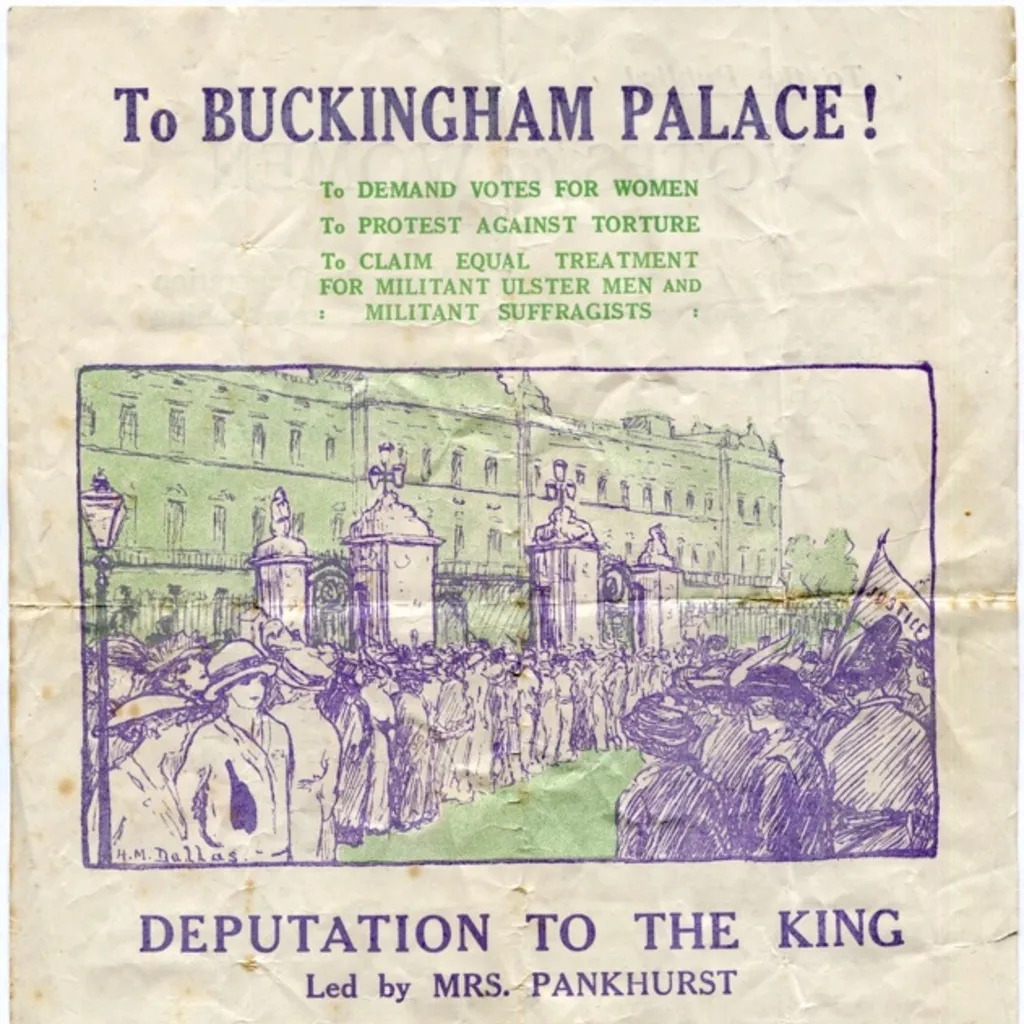
The museum has a small but important collection of material relating to supporters of women’s suffrage in Britain, in particular objects produced by the suffragettes, militant women who deliberately broke the law in order to make their point. The collection includes the board game Pank-a-Squith, a hunger strike medal, suffragette stockings, postcards and other papers. A new item just added to the collection is this striking leaflet, produced to advertise a march in May 1914.
At a time when the world was entering its first great industrial war, there was a last push by suffragettes to obtain the vote. Their efforts would soon be overtaken by the war, putting their cause back by years. On 21 May 1914, though, a large group of women marched to Buckingham Palace. The event was sparked by an earlier occurrence when one of the main organisers of the suffragette movement, Emmeline Pankhurst, requested an audience with King George V to protest against the treatment of suffragette prisoners and he refused to see her. She then wrote to him, saying that his refusal to meet with her was unacceptable, and she would organise a deputation to Buckingham Palace, and expect to see him.
As it eventuated, the protest became notorious when Emmeline Pankhurst was arrested outside the gates, shouting ‘That’s right! Arrested at the gates of the Palace! Tell the King’. Photos of the arrest were circulated around the world and remain iconic images of the suffragette movement. The flyer ‘encourages attendees to ‘come and see that the Women’s Deputation is not assaulted by the police on approaching Buckingham Palace. REMEMBER BLACK FRIDAY when the members of the Women’s Deputation were by Government orders assaulted in Parliament Square … Come and see that these violent and brutal attacks upon women are not repeated on May 21st!’

A leaflet promoting a suffragette march in London on 21 May, 1914. Museum of Australian Democracy collection.
You may also be interested in...
The King George V memorial
How the statue of King George V found its home.
Young people and the right to vote: Some exceptions to the rule
How voting rights have changed in Australia.
The Commonwealth Heads of Government Meeting (CHOGM)
The role of CHOGM for Commonwealth governments.

The history of facial hair and politics
From the portraits of our first Prime Ministers, it is apparent than personal grooming has changed remarkably.
Seven women who made Australian history
How these women changed the political landscape in Australia.
Could a post-Brexit Britain learn something from compulsory voting in Australia?
How referendum votes differ between Australia and Britain.
