Events
The 61 years that Old Parliament House served as the home of the Federal Parliament was a time of enormous change in Australia. The country grew from an Imperial Dominion to a nation in its own right. Over that time, the building was the theatre in which the politics of the day were played out and momentous events took place.
Old Parliament House opens in 1927
On 9 May 1927, thousands of people flocked to Canberra for the official opening of the new Parliament House by His Royal Highness the Duke of York. Invited guests included parliamentarians and their wives, State premiers, judges, bishops, lord mayors, diplomats and senior military officials. They were joined by 15,000 members of the general public, many of whom camped in tents and cars on the paddocks that surrounded the building.
National Library of Australia.
The Duke and Duchess of York arrived in a horse-drawn carriage to a noisy welcome. The tooting of 1500 motor cars added to the cheering and hand clapping. After being greeted by the Governor-General, his wife Lady Stonehaven, Prime Minister Stanley Melbourne Bruce and Mrs Bruce, the royal couple walked up the carpeted steps to join Dame Nellie Melba to sing the national anthem ‘God Save the King’. Unfortunately the main chorus was drowned out as an RAAF squadron flew overhead. Prime Minister Bruce, in top hat and tails, delivered the official welcoming speech. The Duke, in the dress uniform of an admiral, spoke of the opening as ‘a landmark in Australia’s history and the birth of a greater awareness of Australia’s destiny as one of the great self-governing units of the British Empire’.
At 11.00 am, the Duke formally opened the front doors of the building with a large 15 carat gold key, then proceeded to the Senate Chamber for more speeches. In a final ceremony, the Duke unveiled the statue of his father, King George V, which stands today in King’s Hall. The official party then attended a lunch of turtle soup, poached salmon and Canberra pudding. At the time, alcohol was not allowed in the national capital, so the drink of the day was non-alcoholic fruit punch. The crowd outside dined on Sargeants meat pies and scones. However, the organisers had over–catered and two truck loads of meat pies, sausage rolls, prawns and fish had to be buried at the nearby Queanbeyan tip!
The Second World War 1939–45
The years 1939–45 marked a volatile period for the House of Representatives. In September 1939, when it was Prime Minister Robert Menzies’ ‘melancholy duty’ to announce that Australia was at war, there was disunity in his United Australia Party. By 1941, he had resigned and Country Party leader Arthur Fadden became Prime Minister. Fadden led for just 40 days before his Government was defeated on the floor of the House. It was Labor Prime Minister, John Curtin, who declared that Australia was at war with Japan in 1941. He brought stability to wartime administration until his death in office in 1945. Deputy Prime Minister Frank Forde took over for seven days until the Labor Party elected a new leader. Ben Chifley won the ballot. He took office just before the War ended in August 1945.
From 1941, the threat of Japanese invasion was very real for Australians. Like the rest of Canberra, the building was blacked out at night. White lines were painted on the footpaths to direct members back to their hotels after dark. In 1942, US General Douglas MacArthur visited Old Parliament House shortly after he was appointed Supreme Allied Commander in the South West Pacific. Wearing his trademark custom-made silk uniform, he was greeted on the front steps by the Minister for the Army, Frank Forde and taken to the Prime Minister’s Suite. At his first meeting, MacArthur put his arm around Prime Minister Curtin’s shoulders and said, ‘We two, you and I, will see this thing through together. We can do it and we will do it. You take care of the rear and I will handle the front.’
The lives of Australians were regulated so that resources could be directed to the war effort. The Federal Government introduced identification cards as well as the rationing of petrol, food and clothing. Over 900 000 men and women were placed in jobs to support the war effort. Other regulations included conscription for home service and restriction of sporting events. Wartime also changed the role of women. With men away fighting, women took over traditionally male jobs. This shift was reflected in politics as well. In 1943, Senator Dorothy Tangney and Dame Enid Lyons MP became the first women to be elected to the Federal Parliament.
The Federal Election 1949
The Bulletin, November 1949.
In 1949 Australians went to the polls to elect a new federal government. Voters knew at the time that their choice would have a big influence on their country’s future. Should they choose the Labor Government, which had taken them through most of the War and into peacetime? Or should they strike out in a new direction?
Two political parties competed for popular support and presented voters with sharply contrasting policies. The Australian Labor Party, led by Ben Chifley, emphasised a commitment to the less fortunate section of the community and believed governments had a vital role to play in creating the right conditions for full employment, provision of housing and looking after the health needs of people.
Robert Menzies presented the new Liberal Party as the party of free enterprise. In coalition with the Country Party, he promised lower taxes, smaller government and the removal of unnecessary controls. The Liberals also promoted themselves as a party that cared about such social issues as health, education and the welfare of the elderly. Above all they guaranteed the security of individuals and families against communism and socialism.
Chifley mistakenly believed that voters would recognise Menzies and his colleagues as yesterday’s men. The Liberal Party introduced a new style of politics with the recruitment of a publicity firm to help with the campaign. Menzies was portrayed as a man of the people, an imaginative and determined leader, the right man to lead Australia into the future. Advertisements drew attention to his virile leadership, suggesting that Chifley’s approach was tired and his party’s policies old-fashioned.
On election night, as the votes reached the tally rooms around Australia, the trend quickly became clear: the Opposition parties had achieved a huge swing, turning a 40 per cent minority in the House of Representatives into a 60 per cent majority. The Liberals won 54 seats, the Country Party 20, and Labor 47. The victory signalled the beginning of a long period of conservative domination of Australian federal politics. Menzies led the Coalition to victory time and time again, surviving narrowly in 1961 but mostly winning by a comfortable majority. He became Australia’s longest serving Prime Minister: his second term lasted 16 years. The 1949 election turned out to be a landmark in Australian history.
The 1954 Royal Visit
Huge crowds turned out to see Queen Elizabeth II and the Duke of Edinburgh when they toured Australia in 1954. It was Australia’s first visit by a reigning monarch. The whirlwind eight week tour covered all State capital cities and provincial centres and delighted the Australian public. On 15 February 1954, the most significant event of the tour occurred. Her Majesty opened the third session of the twentieth Federal Parliament. She was the first ruling sovereign of the British Commonwealth to do so.
The Queen arrived wearing her cream coronation gown embroidered with the floral emblems of her Commonwealth countries. Before entering the building, the royal couple stood on the front steps to review 4000 servicemen presenting arms in a royal salute. As the national anthem God Save the Queen played, 3,000 school children formed an Australian flag and the words ‘Our Queen’. Thousands of spectators braved wet weather to glimpse the events through a sea of umbrellas. One of them, Meryl Hunter, recalls the rehearsal for the royal visit:
‘The daughter [Heather Menzies] of one of our more famous prime ministers stood in for the Queen and we joined in the laughter as she giggled her way through the ceremony…Some days later we watched the real Queen arrive…in tiara and sash to open Parliament .’
Once in the Senate Chamber, the Queen took her place in the Vice-Regal Chair. She said it was a joy for her to address the House ‘not as a Queen from far away but as your Queen and a part of your Parliament’. She then added, ‘I am the first ruling sovereign to visit Australia, it is clear that the events of today make a piece of history which fills me with deep pride and the most heartfelt pleasure…’
Although the ceremony lasted only 15 minutes, it had enduring significance for the people of Australia .
The Dismissal 1975
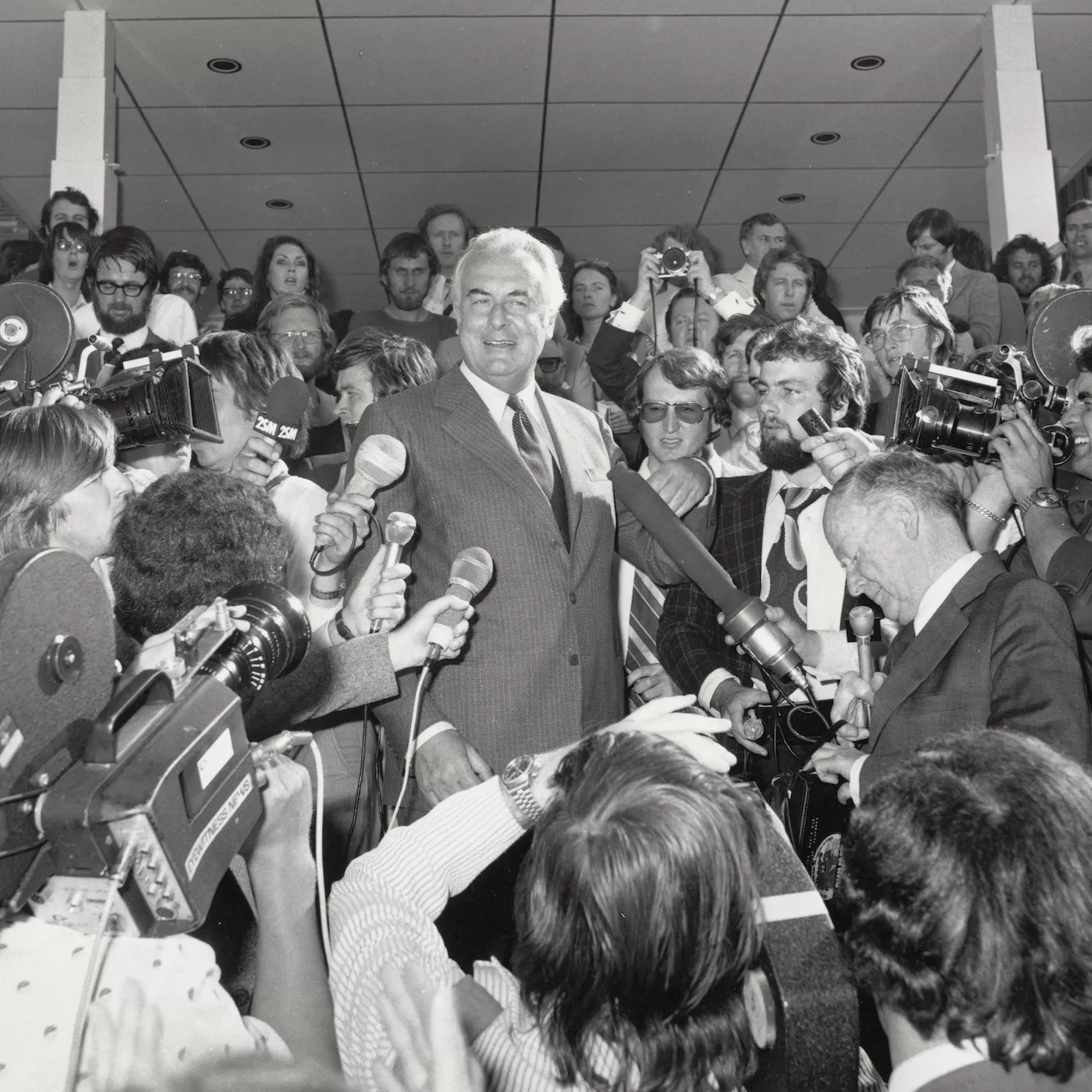
on the steps of Old Parliament House, November 11 1975.
National Library of Australia.
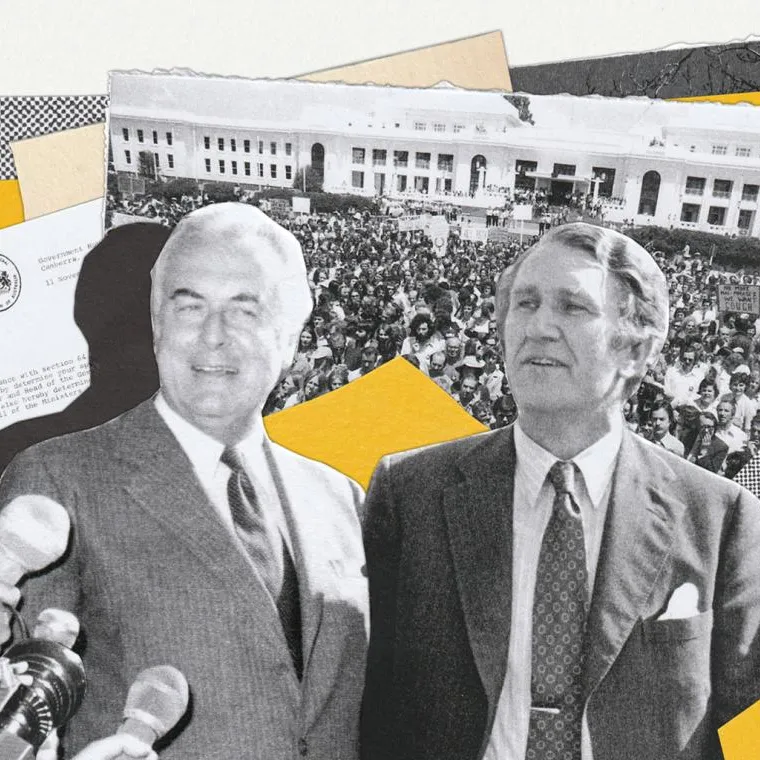
On 11 November 1975, the Governor-General Sir John Kerr met Prime Minister Gough Whitlam in the study at Government House. Kerr handed Whitlam a letter withdrawing his commission as Prime Minister. For the first time in Australia’s history, a governor-general had sacked a prime minister.
This event, commonly known as the ‘Dismissal’, was the climax of a political crisis that began on 15 October 1975 when Liberal and National Country Party senators voted to defer consideration of the Labor Government’s money bills. Such bills, often referred to as supply, are the means by which the government obtains funds to govern. With supply blocked, the Whitlam Government faced the prospect of running out of money by the end of November. For four weeks, the Parliament was deadlocked—neither the Government nor the Opposition would change their positions.
On 11 November Kerr intervened, dismissed Whitlam as Prime Minister and called upon Malcolm Fraser, the Leader of the Opposition, to form a Caretaker Government on the condition that he immediately pass supply and call an election. Supply was passed and both Houses of Parliament were dissolved. The Liberal/National Country Party Coalition won a landslide victory in the election held on 13 December 1975.
Kerr’s decision to sack Whitlam is still surrounded by controversy. There are claims that he deceived Whitlam and acted against established constitutional conventions. Others praise Kerr for bringing the crisis to an end and argue that he acted as he had to. Historians and lawyers will continue to argue over the significance of Kerr’s actions. This debate raises questions not only about what occurred on 11 November 1975, but also about the future shape of Australia’s system of government, the powers of Australia’s Head of State, and the meaning of the Australian Constitution.
Our exhibition website, Dismissed!, takes a more detailed look at the events surrounding the Dismissal.