


1901 opening of the first Commonwealth parliament invitations
Lieutenant Colonel Robert Ernest Williams and his wife's invitations to the event of the year.
The opening of Australia's first national parliament on 9 May 1901 in Melbourne was the culmination of years of work towards Federation. It was the event of the year, and the guest list included royalty, high society, and members of the government. One of those invited was Lieutenant Colonel Robert Ernest Williams and his wife Annie (who went by Claire). Williams was a lieutenant colonel in the Victorian Militia as well as the editor of The Courier, one of the largest newspapers in Ballarat.
Williams and his wife were invited to four events associated with the opening of parliament. Each event had its own elaborately designed invitation.
The first event was the Conversazione, an evening hosted by the Victorian Government, which kicked off the celebrations two days prior to the opening itself. The Conversazione was held in the Royal Exhibition Building in Melbourne. The Gippsland Farmers' Journal described the event as: 'Without, it was a fairy palace glittering like a glorious constellation; within, a vision of greenery, glorious colour, sparkling eyes and wondrous uniforms.'
The invitation features a painting of the Royal Exhibition Building where many of the celebrations were to take place, surrounded by the shields of each of the states that had joined the Commonwealth. The invitation was designed by George Brougham Hubert Austin, an architect in the Victorian Department of Public Works. Austin's background as an architect can be seen in the faithful representations of the Royal Exhibition Building and the skylines of Australia's major cities.
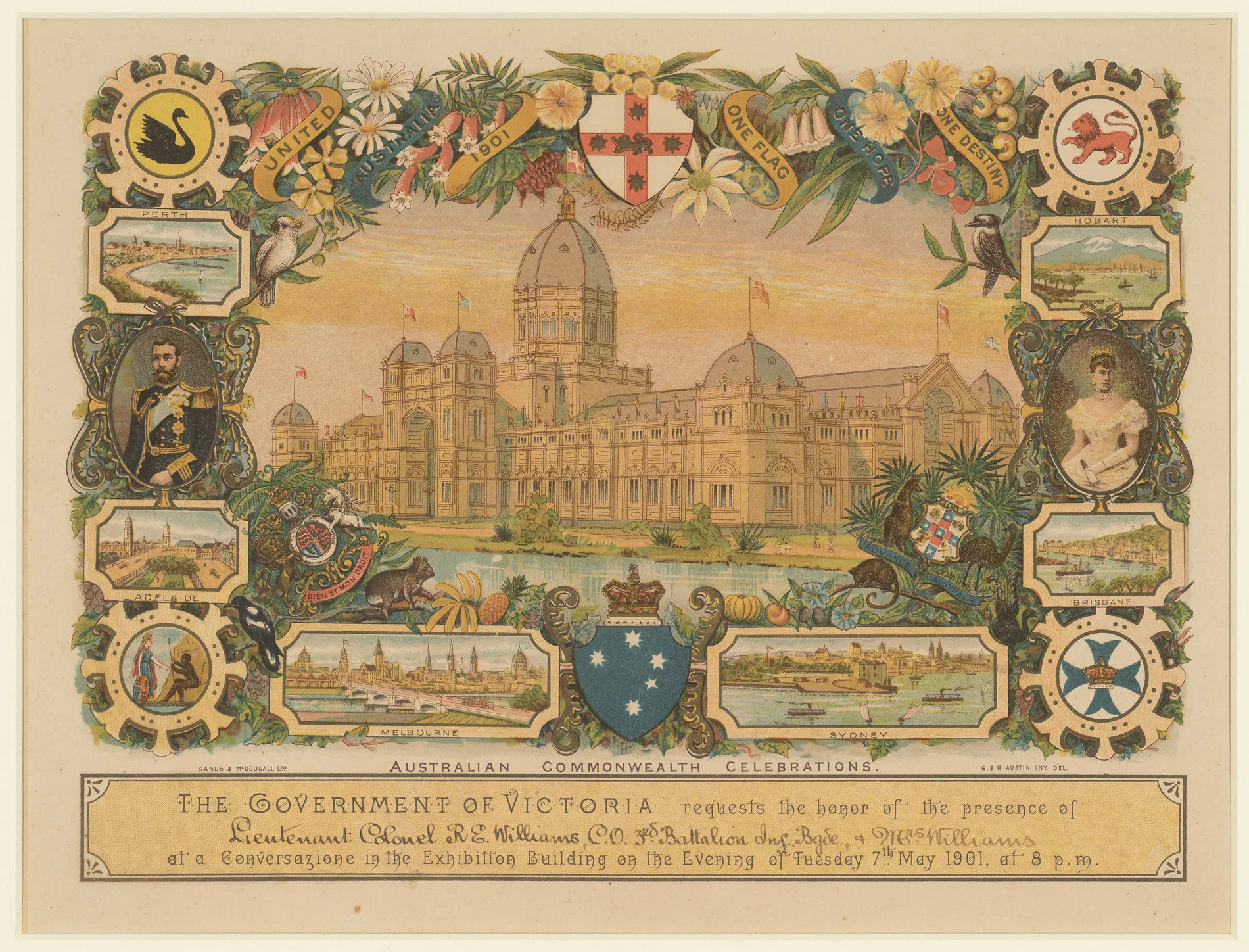
The Conversazione invitation issued to Lieutenant Colonel Robert Ernest Williams and his wife.
Museum of Australian Democracy Collection
The second event was the opening of federal parliament, presided over by the Duke of Cornwall and York, who would later become King George V. Over 12,000 people packed into the Melbourne Exhibition Building to witness the historic moment. The highlight of the occasion was the swearing in of Australia's first senators and members of the House of Representatives, and the Duke reading a proclamation from his father, King Edward VII.
'It is His Majesty's earnest prayer that this union so happily achieved may, under God's blessing, prove an instrument for still further promoting the welfare and advancement of his subjects in Australia and for the strengthening and consolidation of his Empire.'
The image on the invitation is based on the poem Commonwealth Ode by Rudyard Kipling, in which a Young Australia is recognised by Mother Britain. An extract of the poem is included on the invitation.
'Her hand was still on her sword hilt – the spur was still on her heel;
She had not cast her harness of grey war-dinted steel;
High on her red-splashed charger, beautiful, bold, and browned;
Bright-eyed out of the battle, the young Queen rode to be crowned.
Loyal she gave the greeting, royal she bowed her head, crying "Crown me, my mother," and the old Queen stood and said...'
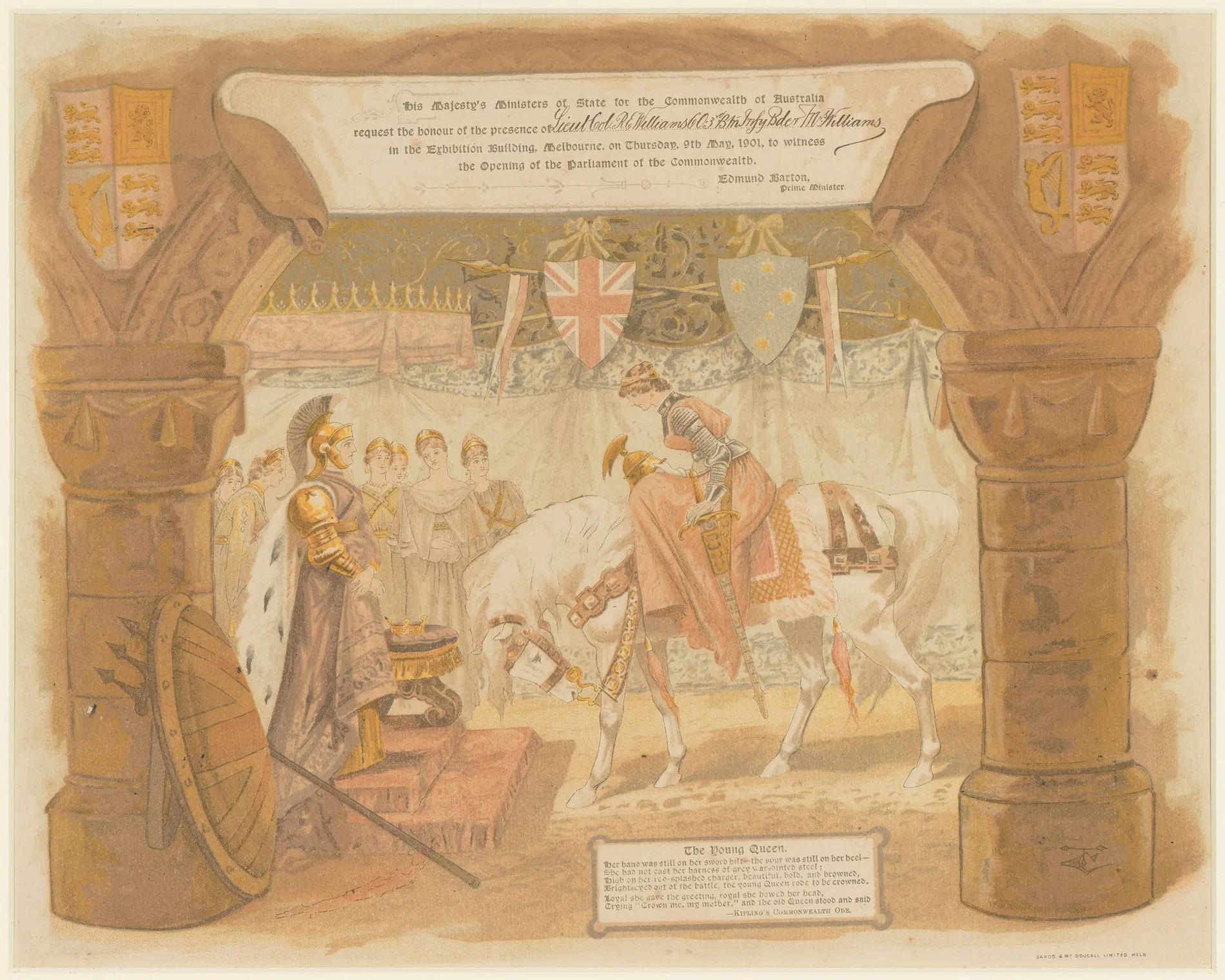
Lieutenant Colonel Robert Ernest Williams and his wife's invitation to the opening of parliament and swearing in of parliamentarians, 1901.
Museum of Australian Democracy Collection
Williams and his wife also attended the reception that evening, which was described by the Evening Journal as, 'On a scale of brilliancy rarely equalled even in England'. It was held by the newly sworn in federal ministers who were described by the Western Mail as, 'Resplendent in Court uniforms with white stockings, Sir John Forrest and Sir George Turner looking particularly gorgeous in their massive gold lace embroideries.'
The evening reception was an opportunity to meet the Duke and Duchess, so the invitation draws upon British imagery rather than Australian. This invitation features oak leaves rather than Australian natives alongside the Royal Coat of Arms. The figure on the right could represent the state of Victoria or the Commonwealth of Australia, it's a counterpoint to the figure on the left representing Britannia.
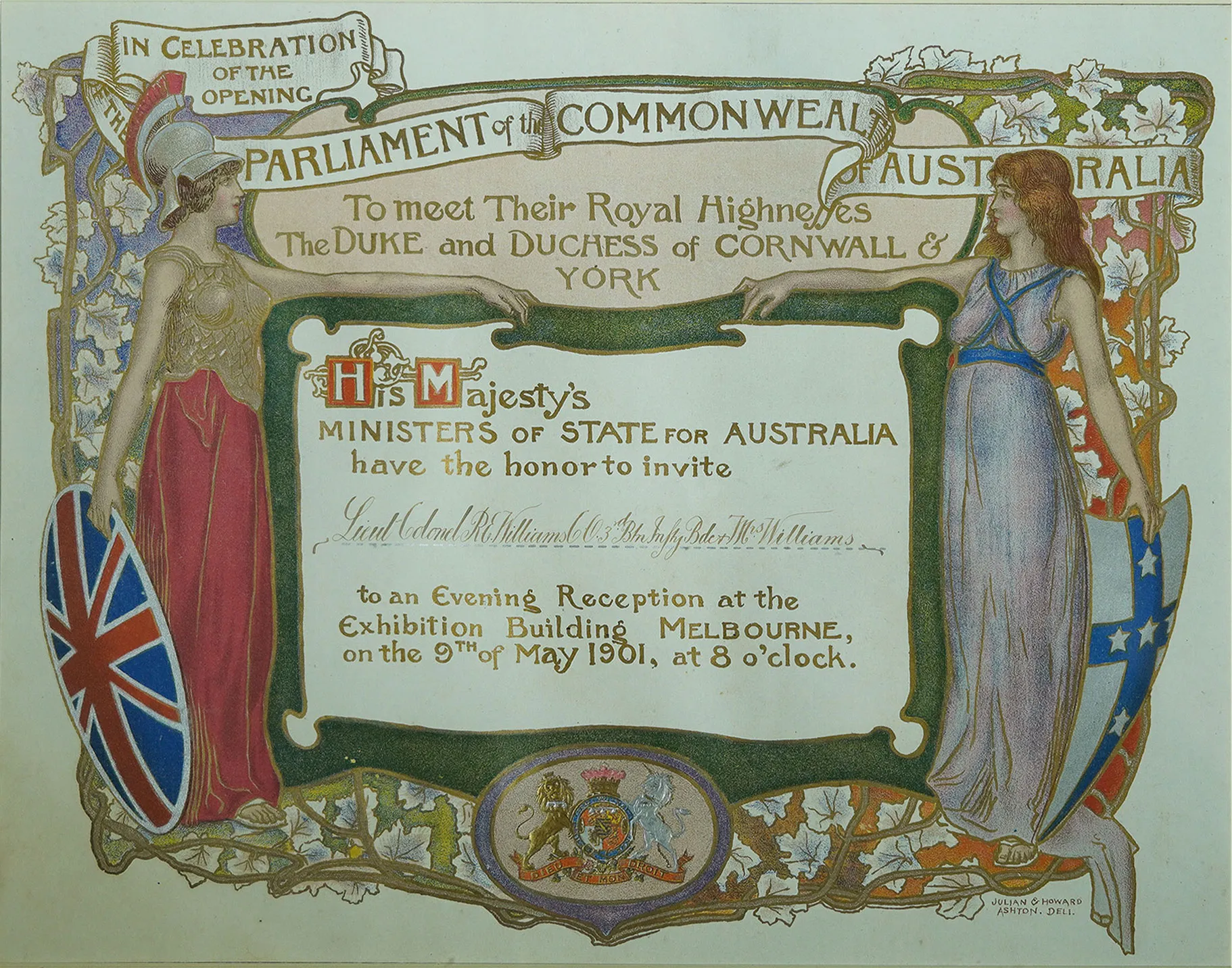
The evening reception invitation issued to Lieutenant Colonel Robert Ernest Williams and his wife.
Museum of Australian Democracy Collection
The final event Williams and his wife attended was the Royal Review. This was a military parade held at Flemington Racecourse the day after the opening of parliament and was attended by, according to one estimate, 140,000 onlookers. Troops from each of the new Australian states as well as other Commonwealth countries were paraded in front of the Duke and Duchess of Cornwall and York.
As a lieutenant colonel, Williams may have participated, but it seems unlikely since he was issued an invitation.
This invitation differs from the others in that it makes use of photography. The photographs depict the Duke and Duchess as well as scenes of Flemington, looking much more rural than it is today. These photographs are accompanied by the standards of the different states and representatives of the different branches of the military.

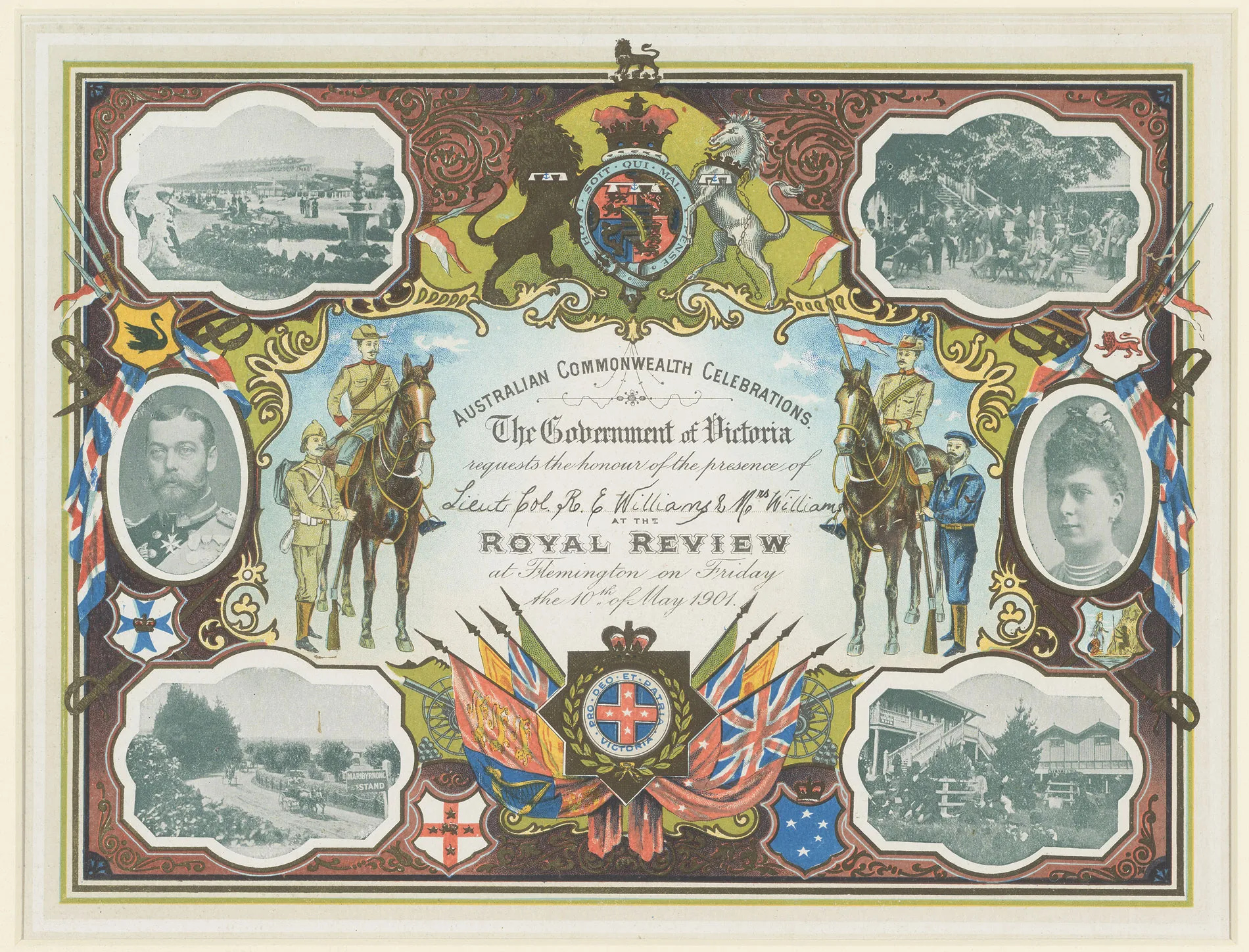
Royal Review invitation issued to Lieutenant Colonel Robert Ernest Williams and his wife.
Museum of Australian Democracy Collection
These were just four of the many events that took place across Melbourne and Australia to celebrate the opening of Australia's first Commonwealth parliament.
Why was the opening of parliament in Melbourne?
During negotiations between the different colonies to form Australia, the issue of the capital was contentious. Both Melbourne and Sydney were considered, but it was written into the Australian Constitution that the capital would be located between them 'in the State of New South Wales, and be distant not less than one hundred miles from Sydney'. Until this new capital could be built, it was agreed that parliament would meet in Melbourne.
What is a Conversazione?
Conversazione comes from the Italian word for conversation and was the name for events where art, literature and science were discussed, but it was also used for parties and events more generally.
Why did it take five months for the first parliament to sit?
The Commonwealth of Australia was proclaimed by Governor-General Lord Hopetoun at the Domain in Sydney on 1 January 1901. After being sworn in himself, the Governor-General then swore in Australia's first prime minister, Edmund Barton, and his ministers. Their role was to set up the Commonwealth government but also to hold Australia's first federal elections. The first federal election was held on 29 and 30 March 1901 and the new members and senators were sworn in at the opening of parliament on 9 May.
You may also be interested in...
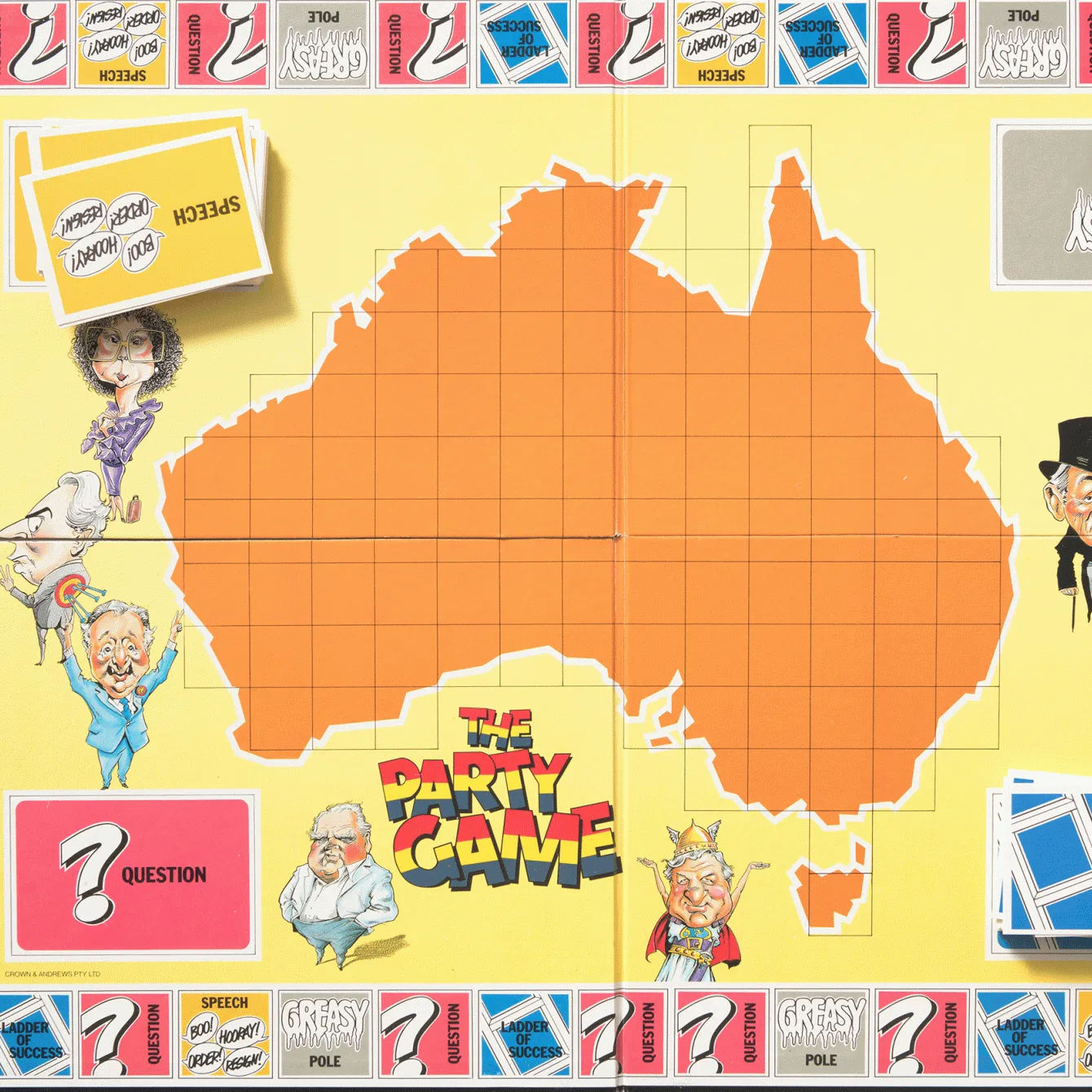
Paul Eddington’s Party Game
A board game featuring a popular actor.
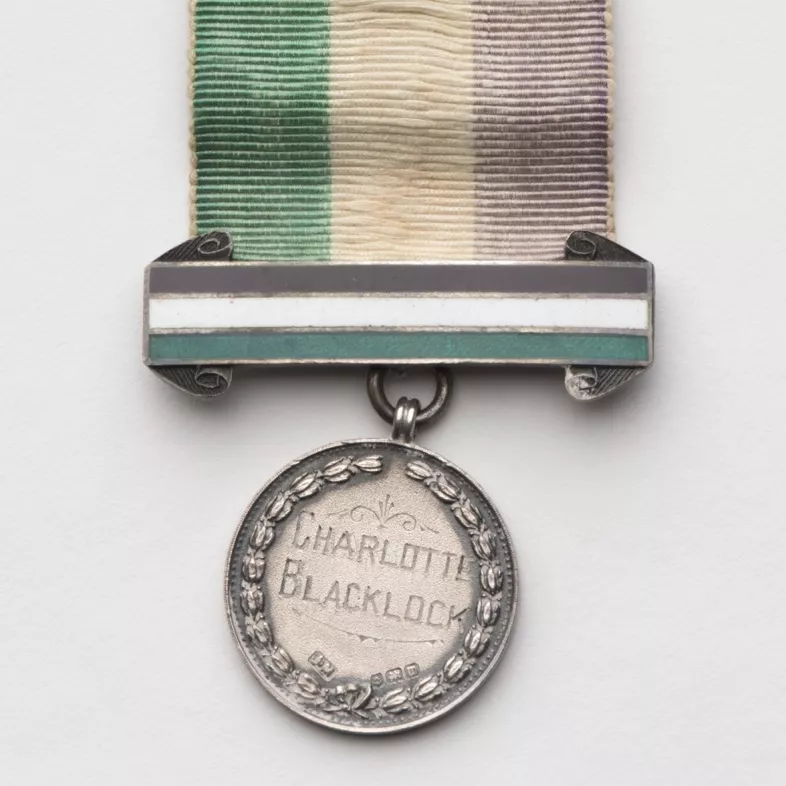
Women's Social and Political Union hunger strike medal
The Women's Social and Political Union took extreme actions to advance the cause of women's suffrage.
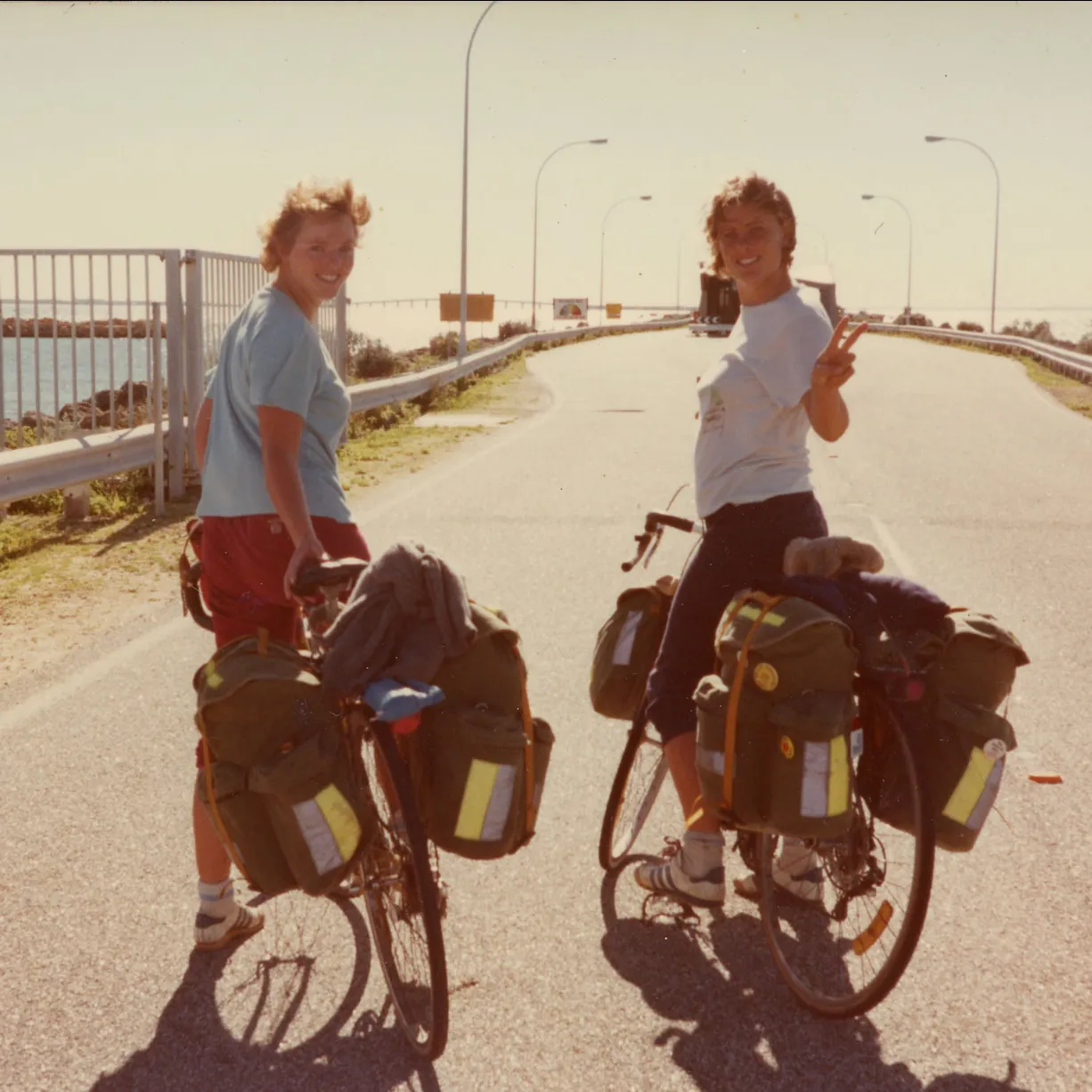
'Bike Ride for Peace' bike seat
How many kilometres would you cover for a cause?
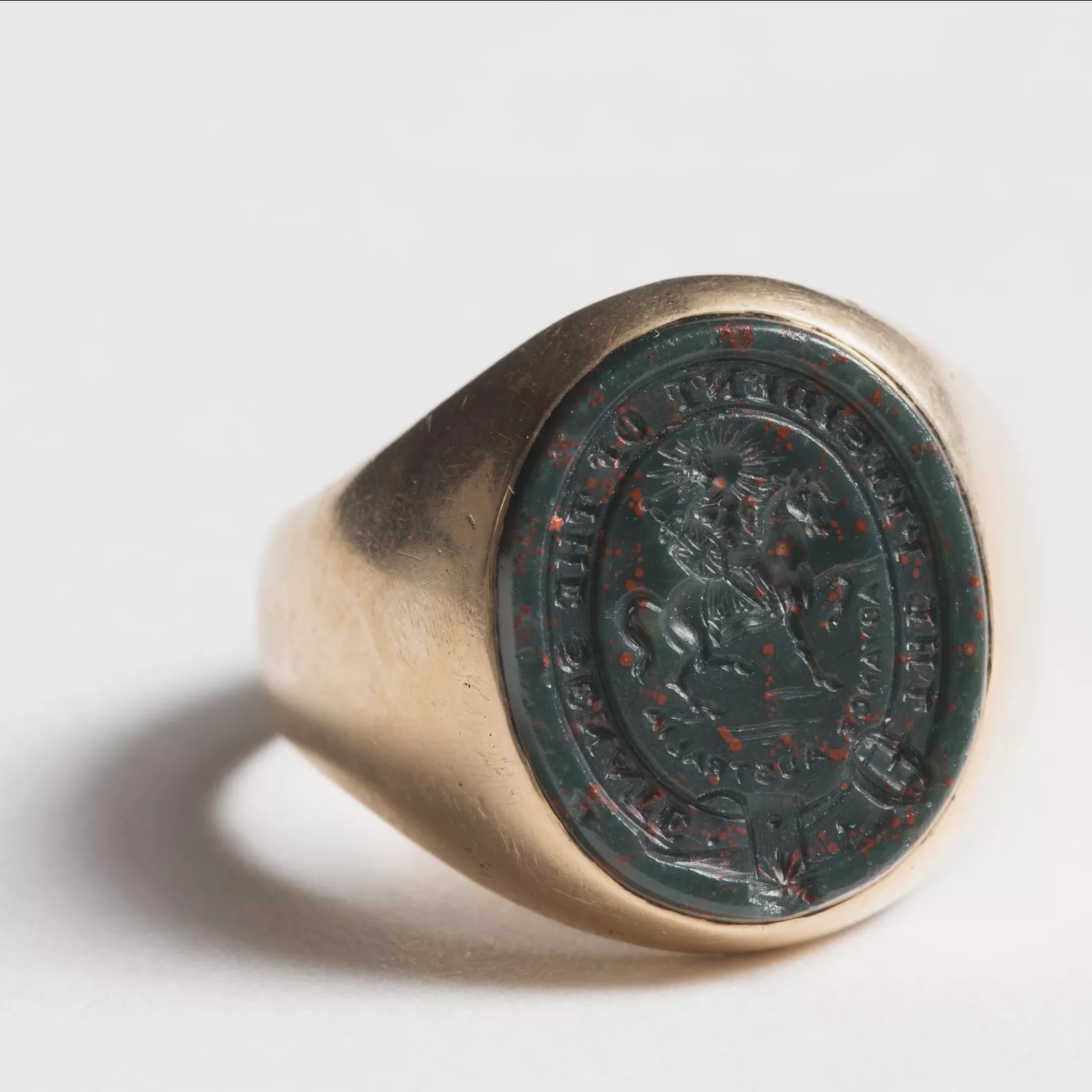
President of the Senate’s signet ring
Australia’s first ever President of the Senate likely commissioned this gold and bloodstone signet ring.
Court dress cufflinks and vesta case
These decorated cufflinks were part of a court dress uniform for the Minister for External Affairs.
Commonwealth of England sixpence
This rare hammered silver coin represents a foundational idea for the history of parliamentary democracy.
